

Your ICP can tell you which companies are a good fit. But fit alone doesn’t explain why one company becomes a customer while another that looks almost identical does nothing.
Every client I’ve worked with had an ideal customer profile. But when we compared it with who was actually buying, the ICP didn’t tell the whole story.
A SaaS company came to me because they wanted to generate more leads.
They had a defined ICP based on industry, company size, and tech stack. Their pipeline was already over 100% of quota. But sales cycles were getting longer, win rates weren’t where they needed to be, and the sales team was working harder. The VP of Sales said they needed “more at-bats,” so Marketing’s mandate was to generate more qualified leads.
First, I recommended we go back and understand what was already happening in their pipeline, so we didn’t replicate the problem with new leads.
We compared a full year of opportunities against their ICP, and the problem became clearer. Their written ICP didn’t align with all the customers who were buying.
We used what we learned from the wins and losses to update their ICP. While doing that, we found something else.
The opportunities that became customers didn’t just fit the ICP. Something was happening inside those companies that compelled them to change. They felt urgency around the problem, were dissatisfied with the status quo, or had multiple stakeholders aligned around solving it.
Other companies fit the ICP, too. They engaged, took meetings, and asked good questions, but ultimately did nothing.
As a result, we stopped treating fit as the final answer and started asking different questions as we updated the ICP:
- Was there a motivating trigger?
- Was the problem creating enough friction?
- Had they already tried something that wasn’t working?
- Was there a reason to make a change now instead of six months from now?
Over the next two quarters, the average deal size increased from roughly $60,000 to $80,000. Win rates improved, and revenue grew 20%.
Same product. Same sales team.
They didn’t add more effective selling time. They got more selective about where they spent it.
It got me rethinking something I’ve been writing about for more than 20 years.
Your ICP describes who. What about when?
Most ICPs are pretty good at describing who: industry, revenue, employees, technology, geography, business model, and technographics. All those things matter.
But I’m more interested in timing. What creates the moment when they’re willing to change? What’s happening inside a good fit company that makes change more likely now?
I’ve traditionally thought about B2B targeting something like this:
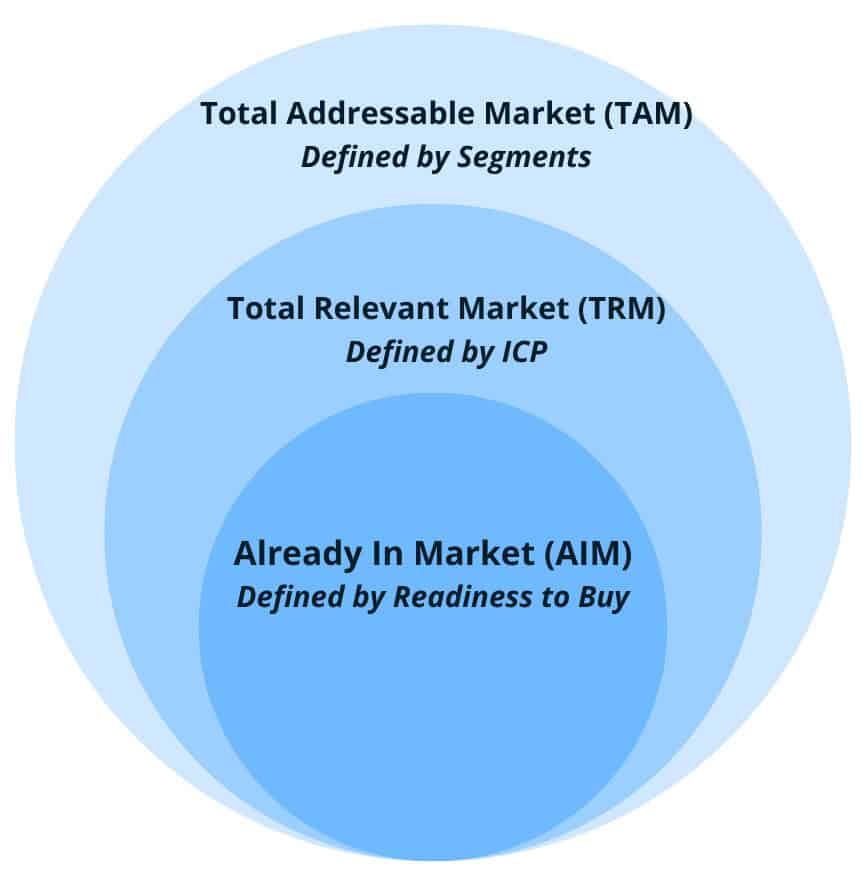
Your ICP helps narrow the total addressable market to the companies most relevant and best fit for what you sell.
Within that group are companies already actively in market (AIM).
What happens between TRM and AIM?
That’s what I’m interested in.
A company can fit your ICP perfectly and have no intention of changing anything. Another company with almost identical characteristics can suddenly become much more motivated to change.
Often, something happened.
A new leader came in. An initiative failed. Maybe there was an acquisition or new competitive pressure.
None of those things means someone is ready to buy. They give you a reason to pay attention.
Trigger events can tell you when to pay attention
Years ago, I mapped out various trigger events that can happen inside and around a company and what they might tell us.
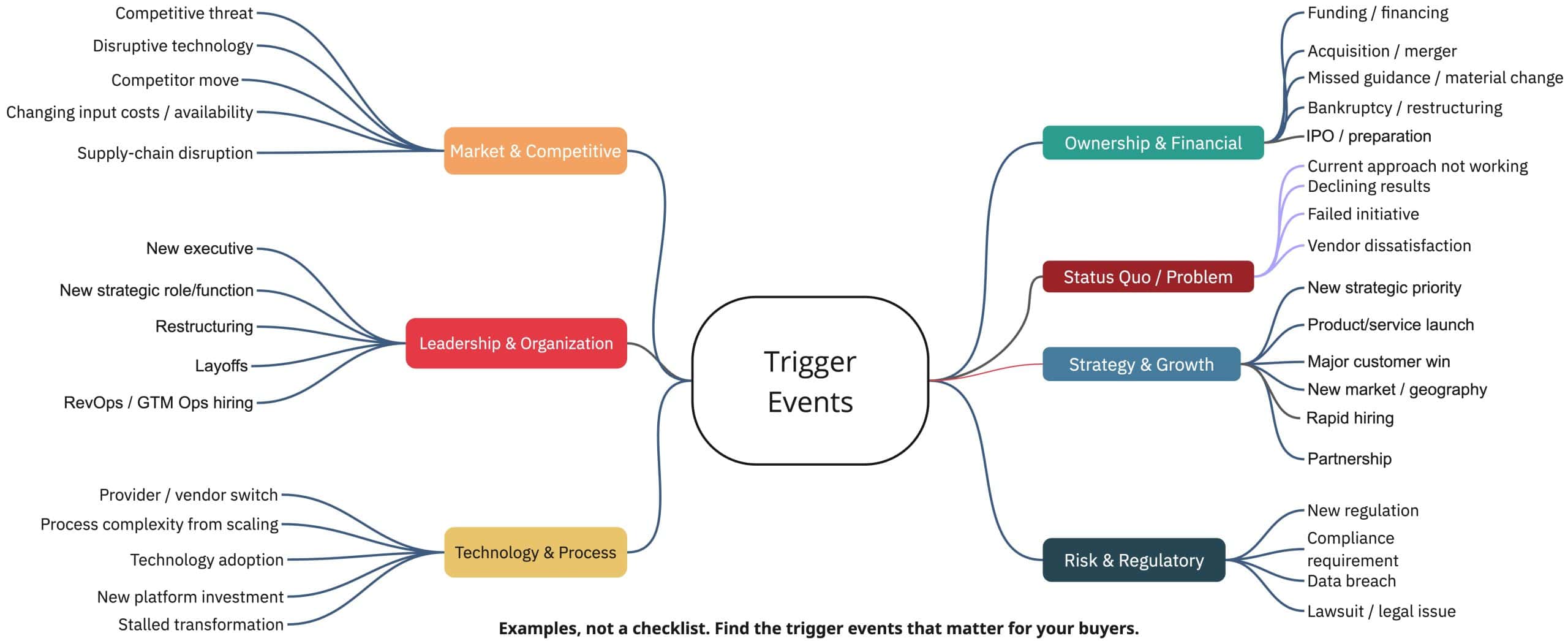
I used to think about these as signals that could help Sales and Marketing focus on the companies most likely to buy right now. I think about them differently now. I treat them more like data points.
It’s a little like trying to predict the weather. You don’t look at one data point and know what’s going to happen. You look at the conditions and the other signals around it to understand what may be developing.
Trigger events work the same way. A new executive might bring different priorities. A failed initiative might create dissatisfaction with the current approach. An acquisition might introduce new complexity. Competitive pressure might make a problem more urgent.
The mistake is assuming you know what the trigger means. You need to dig in further to understand what the data and current conditions are telling you.
One signal increased the probability of buying by 400%
I saw a good example of this with another enterprise SaaS company I worked with that sold product management software.
When we studied their customers, one of the strongest signals we found was surprisingly specific: the CEO publicly used the word “innovation” or a derivative of it.
We tracked this across annual reports, interviews, investor calls, podcasts, and other public information. Companies where the CEO talked about improving innovation had a 400% higher probability of buying than companies where that signal wasn’t present.
It didn’t mean they were shopping for product management software.
It told us innovation had become one of the CEO’s top priorities, which gave us a reason to dig in further and understand what was changing inside the company.
The words “right now”
Craig Rosenberg said something during a recent B2B Roundtable podcast that gets at this:
“The most important thing is there are accounts that are the absolute best fit for you right now. Why would we spend time on anything else?”
The words “right now” stood out to me.
There’s a difference between asking, “Is this company in our ICP?” and asking, “Is this a good fit company with a reason to change right now?”
A good fit company without a reason to change may need your marketing, ideas, trust-building, and patience. One where the circumstances are changing may deserve closer attention from Sales.
So, is your ICP wrong?
Not necessarily.
When pipeline slows, you could be targeting too broadly. Sales and Marketing may disagree about your best customers. You might have the right companies and the wrong message. Or you may have identified good fit companies without understanding what makes some of them motivated to change now.
All of those problems can look similar on a dashboard: lots of activity, but not enough revenue.
That said, if you haven’t revisited your ICP against the customers who actually bought in the last 12 months, I’d start there.
That’s why I keep coming back to diagnosis before prescription.
Before changing your ICP or generating more leads, look at what separates the customers who bought from the good fit opportunities that didn’t.
Start with your recent wins. Don’t just study who they were. Look at what was happening when they decided to change:
- What triggered the search?
- What motivated them to start looking?
- Why then?
- What had they already tried?
- What made maintaining the status quo harder?
Then look at the good fit accounts that went nowhere. What was different? What was missing?
Pay attention to the patterns.
Your ICP tells you where to look. Trigger events can help you know when to pay attention.
Most ICPs describe a market. The best ones also describe a moment.
B2B Trigger Event Worksheet
I put together a B2B Trigger Event Worksheet in Google Sheets with examples of signals, what they may mean, and what to investigate next.
View and Copy the B2B Trigger Event Worksheet →
ICP Fit and Buying Readiness AI Skill for Agents
I also turned the framework behind this article into an open-source AI skill you can use with your own agents.
It helps an agent separate company fit from buying readiness, distinguish what’s known from what’s only a hypothesis, and identify what still needs to be investigated or confirmed in discovery.
The idea is the same: fit tells you where to look. Readiness helps you understand where there may be a reason to change.
View the ICP Fit and Buying Readiness skill →
Not sure whether your ICP is the problem?
When your GTM generates activity but not enough revenue, the answer isn’t always more leads or a new ICP.
I help B2B leadership teams understand what’s actually limiting growth, align on what to fix, and help their teams make the change.
Take the GTM Maturity Assessment →
You may also like:
Ideal Customer Profiles: 5 steps to ensure your lead generation stays on target
AI Scaled Activity. It Didn’t Scale Relevance with Craig Rosenberg
 No hype. No noise. Clarity your team can actually use.