

Subscribe: Apple Podcasts | Spotify | Youtube Music | Email Updates
About This Episode
Most GTM teams are using AI to make existing work faster. But faster isn’t the same as different. And the teams that are actually pulling ahead aren’t automating the past — they’re reimagining the work itself.
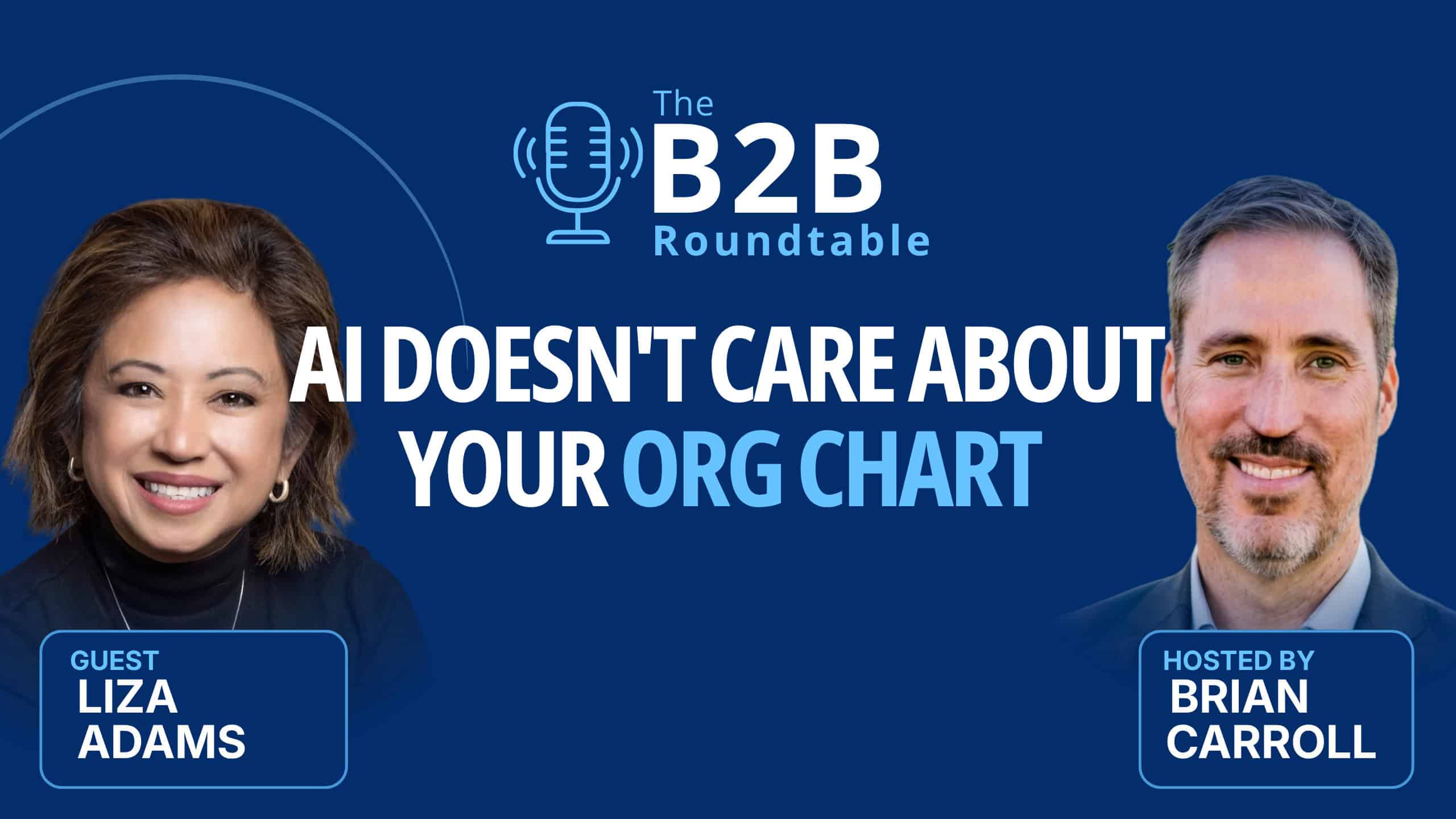
In this episode, Brian talks with Liza Adams about what separates teams that are getting faster with AI from teams that are actually changing how they work. Liza shares the story of Megan, a senior marketing leader who used AI agents to orchestrate across marketing, sales, and CS until her work outgrew her title entirely. That story illustrates the bigger idea behind the conversation: what happens when you reimagine the work first, then redesign the roles and the org around it.
About Liza Adams
Liza Adams is the founder of GrowthPath Partners, where she helps B2B GTM teams move beyond AI productivity into AI-driven transformation. She spent 25 years leading GTM teams at companies including Smartsheet and Juniper Networks, and has worked with AI and machine learning long before ChatGPT. She is passionate about elevating the strategic value of marketing and helping leaders use AI to become business leaders, not just functional leaders.
What We Cover
- The AI adoption plateau and the three patterns that cause teams to stall
- Why your belief about what AI can do is the cap of what your team will ever build
- Using AI as a sparring partner vs. a validation tool, and the research behind why it matters
- The difference between what’s hard for humans and what’s just historically hard
- How AI doesn’t care about your org chart, your silos, or your titles
- What CEOs are starting to want from CMOs and why most marketing leaders aren’t set up for it
- Why reimagining the org chart starts with reimagining the work, not the other way around
A Few Things Worth Taking Away
- AI for productivity should be the floor of our expectations, not the ceiling. If we only make old work go faster, we can project how it automates the human out. But if we use AI to do something different, we’re innovating, and when the business grows, humans are essential.
- People aren’t stupid. They just need to see what’s possible. Talking about AI capabilities is different from showing someone a workflow that pulses the market 24/7 and surfaces which customers are about to churn.
- Humans that use AI as a sparring partner outperform pure human teams and pure AI teams. But humans that use AI to validate their beliefs actually perform at a lower level than an all-AI team.
- In the RACI model, AI will never have the A. It will never be accountable. It will never lose the job for you, pay the fines for you, or go to jail for you.
- Don’t start with “what does the org of the future look like?” Start by reimagining the work. When you reimagine the work, the roles become clear. When the roles are clear, the org chart follows.
A Few Lines That Stuck With Me
- “The cap of what our teams will ever build, do, and use AI for is limited by what they believe it can do.”
- “AI transformation can’t happen when we’re in a hamster wheel.”
- “AI will never lose the job for you, it will never pay the fines for you, and it will also never go to jail for you.”
- “It’s like hiring a bunch of actors before you even know what the script is.”
- “AI is making the mechanics a lot easier. I think our biggest challenge now is us.”
Resources Mentioned
- AI Is Cannibalizing Human Intelligence. Here’s How to Stop It. by Vivienne Ming (Wall Street Journal)
- What Harvard Learned From 776 Professionals Using AI (Harvard/P&G research on AI and cross-functional collaboration)
Chapters
- 00:00 Why Getting Faster With AI Isn’t Enough
- 03:20 Why Teams Hit the AI Adoption Plateau
- 07:43 AI as a Teammate, Not Just a Tool
- 10:10 Using AI as a Sparring Partner
- 12:35 What Work Is Only “Historically Hard”?
- 18:12 AI Can Do the Work. Humans Own the Outcome.
- 19:32 From Org Charts to Work Charts
- 26:19 What CEOs Need From CMOs Now
- 34:33 Reimagine the Work Before the Org Chart
Transcript
Brian Carroll (00:00): Well, I see this a lot in sales and marketing teams. People are using AI, some are using it really well. They built workflows, they built custom GPTs, they’re getting faster and better. But there’s a big difference between getting faster with AI and actually changing how your organization works. Welcome to the B2B roundtable. I’m Brian Carroll. And my guest today, Liza Adams. She’s the founder of GrowthPath Partners.
And she spent 25 years leading GTM teams at companies like Smartsheet, Juniper Networks, and she’s worked with AI and machine learning long before ChatGPT. And now she helps teams figure out how AI can actually change the way they work. Something Liza recently said that stuck with me is you can’t reimagine the future by automating the past. Liza, welcome to the B2B roundtable.
Liza Adams (00:50): Hi Brian. I’ve been looking forward to this all week long and it feels like every time you and I get together we’re always laughing. So I’m still kinda laughing over here. So always a pleasure.
Brian Carroll (01:02): I’m so glad to have you on today. And it’s funny, I’ve had multiple people tell me, Brian, you should talk with Liza Adams. And it was fun to be able to say, Well, guess what? We’re talking this week.
Brian Carroll (01:16): So the question I wanted to ask you first is what’s really separating teams that are changing how they work from teams that are just getting faster?
Liza Adams (01:25): Yeah, you know, the biggest aha moment for me is really mindset, right? Like I’ve always said that the cap of what our teams will ever build, do, and use AI for is limited by what they believe it can do. So if we primarily think that this is gonna be just a chatbot or a fancy search engine.
Guess what? That’s all we’re ever going to use it for, right? And I do have a lot of empathy because if that’s what we believe, and our companies are expecting us to build fully agentic workflows that cross functions, guess what?
There’s a big grand canyon between those two beliefs, right? And that’s just one. You know, there’s also this mindset around AI used for productivity, making existing work go faster. And I actually believe that that should just be the floor of our expectation of AI. Because if we simply make old work go faster, you can almost project how it can automate the human out.
But if we actually use AI to push our thinking so that the outputs are better, so better, not just faster, but better. And then better yet, if we actually use AI to do something different, meaning reimagine the work. We now are innovating, do things that weren’t possible before. With innovation, you know, we have a better shot at growing the business. And when the business grows, humans are essential.
Right? And I actually can’t see a business continuing to grow without needing more humans. But if we simply improve productivity, then we can see how humans are not as essential to the business.
Brian Carroll (03:14): Something I’ve noticed with companies is when they do start using it, and every company has to varying degrees, there’s this AI adoption plateau. And I wanted to talk to you about it because I hadn’t really heard that until our conversation. So what does that look like inside a real company?
Liza Adams (03:34): Yeah, a few things come to mind and again, Brian, you and I have talked about this before the show, right? That I don’t have best practices because I do believe best practices are still being written and they’re evolving and they’re moving so quickly and oftentimes the shelf life is relatively short. But what I do have is pattern recognition, having worked with and continuing to work with a lot of go to market teams. So I’ll share with you my thinking on what I’m seeing.
Time and time again, and some of these patterns, you know, tell me what generally might work and what generally is going down the wrong way, right? And I think again, the mindset, right? Like what you believe AI can do is the cap of what you will ever build. So if we don’t shift that mindset, there’s a plateau there at some point, right? The other thing is,
being able to see what’s possible. So people, I know this so well now, people aren’t stupid. They just need to see what’s possible. I mean we can talk to them till they’re blue in the face, that you can build agentic workflows across functions. And then these agents can use tools, it can use our browsers, it can
you know, navigate our systems and our laptops and put files in the folders. But those are features of AI, those are capabilities of AI. We actually have to show them what’s possible, right? So you know show them how it can pulse the market consistently and give us insights 24 by seven and be able to tell us what is still aligning with positioning and what isn’t.
Like show them what that looks like, right? Show them how we can use signal from various sources, and those various sources might have lots and lots of data. AI can collect all that, synthesize it, give us insights and anomalies, and determine which customers are about ready to churn, or which customers are giving us enough signal that they’re probably a good candidate for an expansion. So think about those workflows, not just the capabilities.
Until they see what’s possible, there’s gonna be a plateau, right? So the whole notion of inspiring people, what’s possible, sharing you know, these use cases, sharing these workflows, everybody doing it, because the ideas are brand new, right? No one’s ever navigated this before. So we need like absolutely the rising tide lifts all boats in many instances. The other place where I’m seeing a plateau is
where we do workshops and we do trainings and things like that. So we inspire people, they get going, but then we go back to our day jobs. And what happens is I’ve always said, you know, AI transformation can’t happen when we’re in a hamster wheel.
So we actually need to give people the space, the time, the safe space and time to learn, right? Because this isn’t a one and done, do a workshop, do some training, and check mark, you’ve transformed. It doesn’t happen that way. It truly is a change, human change management journey, right? We need to consistently reinforce. You know, people need to keep trying, need to keep using it. And then at some point it becomes a habit, right? It becomes a behavioral change.
And unless we have that kind of environment in the company, then I believe that we do hit the plateau again. So I think between those three things, those are roughly the three things that I’m seeing across GoToMarket Teams.
Brian Carroll (07:26): Any tips or things you’ve learned about that in terms of that plateau? If someone’s like, I think we’re at a plateau now where they might be able to maybe hit the reset button a little bit.
Liza Adams (07:37): Yeah, so this is actually kinda interesting, but I’ve used it on many, many teams now. There is this prevailing perception that AI is primarily a tool.
And in a lot of instances, you know, we use it in that way. But if we actually shift the thinking and kind of reframe that a little bit, I generally use the superhero analogies because I love superhero movies like The Avengers or The Justice League, where you have different superheroes working together as a team. Each one has different superpowers or complementary in nature and they overcome each other’s weakness.
And then when you bring them together, they basically defeat evil and save the world.
In the world of AI and humans, I believe the same thing that humans and AIs have highly complementary superpowers, right? And I’ve given this example time and time again, and I use myself because I have super bad memory, Brian, and you know, as I age, it’s not getting better. I think I killed a lot of brain cells in college drinking beer, and then now it’s just affecting me.
Brian Carroll (08:49): Ha ha ha.
Liza Adams (08:50): And as a human, I can’t be my best self every day. Like today I’m having a great day, right? But you know, some days I’m overwhelmed, I’m frustrated, I’m overworked, you know, I’m sad or I’m sick, and in those days I can’t be my best self. AI, on the other hand, has super good memory, much, much better memory than I do.
And it also is not affected by its environment. It doesn’t care what’s happening around it. It continues to analyze data. It continues to write a blog or whatever we’re asking it to do, right? So in those days where I’m not my best self, AI is helping me overcome those weaknesses. However, on the other hand, AI doesn’t have Liza Adams’ moral compass.
Brian Carroll (09:36): That’s right.
Liza Adams (09:37): It has Google’s and OpenAI’s and Anthropic’s moral compass, but it doesn’t have mine. It doesn’t understand my passions and my goals. It doesn’t understand my clients’ challenges. So I have to guide it, right? And I have to guide it to align with my intent. You know, AI is a mirror of whoever’s using it, intent. And so, you know, when you think about humans and AIs working together, I really do believe
that we can overcome each other’s weaknesses. So I tend to use AI a lot as a sparring partner. Where it’s a thinking partner. It’s not to just validate my thinking or confirm my thoughts, right? It’s actually there. Like I have a digital twin in Claude, and I have a digital twin in ChatGPT. It’s there to actually find my blind spots. It’s there to help me understand different perspectives, how
my beliefs might be perceived by others who may not believe in the same things that I do. And it’s there to challenge my beliefs and assumptions. So you know I think when we think about AI in that way, we begin to go outside of what we would normally think.
Right? Because now we have more diverse points of view, we’re more empathetic to different kinds of people. And then ultimately the output is a lot better. And I don’t believe that I’m the only one saying this because there’s this American neuroscientist. Her name is Vivienne Ming.
And she wrote about this in the Wall Street Journal maybe a couple of months ago. And she did a study of humans using AI. And she determined that humans that use AI as a sparring partner outperformed humans, pure human teams working together, and pure AI teams working together. However, humans that used AI to simply validate their beliefs
actually perform at a lower level than an all-AI team. So,
Brian Carroll (11:42): Wow.
Liza Adams (11:42): because if you’re simply using AI to validate your thoughts, you’re at risk of confirmation bias. And you’re going just down this rat hole, just your belief, right? But when you use it as a sparring partner, it expands the aperture and it allows you to think more deeply about it.
Brian Carroll (12:01): I really like that. And I was thinking about even my own experience. That is something I’m like, what am I missing? What didn’t I think about?
But a lot of us are using AI individually as that sparring partner. And I was curious, how do you get from the individual getting good at AI to taking the individuals and helping the whole team or organization get better from how the team collectively uses AI?
Liza Adams (12:29): Yeah, so back to my superhero analogy and also reimagining work, right? Because I think it will connect us from benefits to just one individual to ultimately benefits across teams and even across functions and organizations. When I think about reimagining work, you know, doing things that weren’t possible before, I start with what was really hard for humans to do.
What was hard, what was really expensive, or just really difficult to do manually at scale, right? But then now with AI, those are no longer hard. Those are now historically hard, right? So for example, and I mentioned this earlier, you know continuously pulsing the market 24 by seven.
Understanding what competitors are doing, what the analysts are saying, how customer behaviors are changing. Because we constantly need to keep track of ensuring product market fit, right? If all of a sudden the market shifts, you know, in the past we might do that like once a year. Maybe if we’re lucky, we pulse the market quarterly, and the product marketing person looks at what’s happening and has an analysis. Well, things are moving so quickly right now, anything that you made decisions on last quarter
is no longer valid, right? But it was hard for humans to go 24 by 7 looking at the market at what the market is doing because we need to sleep. And we also don’t have a lot of humans and don’t have a lot of money to pay those humans to do pulsing the market. So that’s one. So now AI makes that possible, right? The other one is what I mentioned where lots and lots of sources of data.
And then there’s lots of data within each source, trying to figure out what all of them are saying to give a signal about the customer. Hey, is this gonna churn? Is this going to be good for expansion? That kind of thing. That’s really hard to do because the human, even our tools today, are not equipped to do it super well. So, but now AI is able to do it, right? Anytime, you know, what’s hard today is like the handoffs between teams.
Marketing campaign brief with messaging, handing off to sales with sales enablement, handing off to CS with customer onboarding. Every time you have a handoff across those functions, something falls through the cracks. And then when there’s a change,
some of those changes don’t get handed off. So think about the customer experience, right? Customer goes from being served by marketing to sales and then CS. Guess how, it’s like playing a game of telephone. By the time it gets to CS, nothing has been relayed. A very small percentage has been relayed all the way to CS, right? AI, on the other hand, can hold full context end-to-end because it doesn’t care about our silos, it doesn’t care about our
functions, doesn’t care about our titles or roles, it only cares about outcomes, and it shares all that data and insights all the way across. So, what was hard for human beings? So the question becomes: is it hard or is it just hard historically? Because I would contend that
if we ask that question of our workflows today, a good percentage now we could put in the just historically bucket.
And many of the workflows that I just described begins to pull us together, right? It’s no longer just a productivity tool for Brian or Liza. This is now something that impacts marketing, sales, and CS. You know, when we’re pulsing the market, figuring out whether we still have product market fit, guess what? That’s a strategic decision that impacts the entire company, not just the product marketer.
When we now begin to see which ones are going to churn or which ones are ready for expansion, that’s not just helping Brian, right? That’s helping the entire organization figure out upsell, cross-sell opportunities. So, you know, I just think there’s so much power in AI that the first place that we need to look at are things that we skipped
in the past, because it was hard for us because we’re humans, but now it’s less hard because AI has a different set of superpowers.
Brian Carroll (17:08): That is a great takeaway. And the things you talked about are the things that don’t easily show up on the dashboard. It’s the stuff that gets missed we can go deeper in and make it better.
Previously a lot of the work was spent on collecting the data. Now we can spend more time sense making. What are we seeing? How can we do that? And that’s the part that I see you talking about this reimagining.
Liza Adams (17:31): Yeah, and you know, spot on Brian. AI helps with the connection, AI helps with the synthesis, begins to give us insights that we may not have originally identified, right? But ultimately we are the, we still judge. We make the final call, right?
So use AI to help us get all that stuff. But you know, someone told me that in the RACI model, you know, responsible, accountable, consulted and then informed. AI will never have the A. AI will never be accountable, right? That human being will always be accountable. Even if AI did the work, the final judgment is still on us. And I’ve always said, you know, AI will never lose the job for you, it will never pay the fines for you, and it will also never go to jail for you. So
Brian Carroll (18:28): Ha ha ha.
Liza Adams (18:29): Which I still love because if it did, then why are we here? Right. So
Brian Carroll (18:34): That’s right.
Liza Adams (18:35): I love the fact that there’s vulnerabilities and AI is imperfect because we are still ultimately accountable. And when we’re ultimately accountable, it forces us to guide AI responsibly the whole way.
Brian Carroll (18:48): And a lot of the work that comes through AI could be transformed just by someone signing off and saying I’m accountable for what this says. Because they ultimately are. It’s just that sometimes people skip that step.
Liza Adams (19:03): That’s right. That’s right.
Brian Carroll (19:05): You touched on this earlier, which is this idea of the organization. So moving from an org chart to more of the work chart, how work’s happening and I wanted to see if you could share how you’ve seen a company actually start working this way.
Liza Adams (19:22): Yeah, I hinted a little bit about it already. So org charts, as everybody knows, it’s highly siloed. We’ve got marketing, sales and CS, even in marketing, right? We’ve got digital, we got brand, we’ve got demand gen and field marketing and partner marketing, you name it, right? And then it is also very hierarchical. You’ve got your CMO and then your VPs, directors, managers. AI, in the world of AI, as I mentioned, it doesn’t care. It doesn’t care if you’re CMO or analyst, and it doesn’t care if you’re sales, CS, or marketing. And in fact, there’s the study from Harvard. They took 776 P&G professionals.
And they were cross-functional. And when they gave these professionals AI, the observation was that they began to care less about the boundaries of their jobs.
Because AI didn’t care, right?
Brian Carroll (20:24): Right.
Liza Adams (20:25): Yeah, so it only cared about the outcomes. And in fact, I’ve written about this. There’s this woman named Megan. I was with this team for about six months. Megan was the senior director of integrated campaigns and demand generation. So she had a number of agents, AI agents, to help her with campaign strategy, campaign planning, and campaign execution. And then she orchestrated them. And then she’s like, why am I stuck
stopping in campaigns because at some point I need to enable sales, right? So she actually created this sales enablement agent. And then she’s like, well, why am I stopping at sales? Because at some point, this product that this campaign is promoting will be sold to a number of customers, and CS will actually have to support that product. So she created this CS onboarding agent. Lo and behold, she is now orchestrating
a full go-to-market agentic workflow that goes from marketing, sales, and CS. And the result of this is Megan has essentially worked herself out of her senior director of campaigns job. She is no longer that, she is now the senior director of go-to-market strategy and architecture.
Her job is very different today. Like in the past, it was the typical create a campaign brief, bring everybody together, cross-functional team meetings so that everybody aligns on that brief, execute on the assets, look at the campaign performance, determine what needs to be tweaked.
Now, what she’s doing, she’s building and training these individual AI agents. She’s guiding them. The agents are doing the work, right? She is judging the work. She’s guiding the insights. Then she’s determining whether or not to shift strategy based on what the agents are finding out. So her work has become more strategic, more judgment focused, more guiding.
And more orchestrating now across functions rather than campaign development, launch, execution, and performance management. So that is a very real example of how AI has changed not just the individual, but also the function and the role of that individual.
Brian Carroll (22:55): I think that’s something people are gonna wrestle with, especially those who want to hold on to what the org chart was. What you’re just illustrating is that AI enables us to overstep what the org chart is because, like you said, it doesn’t care.
And what I love is how she was able to frame this out in a way that it’s solving the problem, which is orchestration, and now moving into that role helping orchestrate.
Liza Adams (23:24): Yeah, and you know, the great news about what she did is AI didn’t care about the silos. She didn’t care about the silos. She still worked with a specialist, right? But she didn’t care about the silos. And
guess what? The customer doesn’t care about our silos, right? Like in fact they don’t want to know the sausage making and I’ve had some enterprise customers say, I feel like I’m dealing with three companies rather than just one company. Because every time we hand off from marketing to sales to CS it feels like three different companies, right? But now with AI, we have such an opportunity to create that seamless experience all the way across, which really leads to
I think AI is making the mechanics a lot easier. I think our biggest challenge now is us. It’s humans, right? We have egos, we have politics, we have ingrained cultures, we have fears and all sorts of things. We also have KPIs that line our pockets very differently.
And we’re measured on those KPIs, and they tend to be highly functional in nature, right? And what I’ve just described is outcomes-based. But guess what? We’re still KPI’d in marketing on MQLs. We’re still KPI’d in sales based on closed deals, and we’re KPI’d in CS based on renewals.
Brian Carroll (24:50): Mm-hmm.
Liza Adams (24:51): We all know that each one of those departments can achieve those goals and the customer might still be dissatisfied. CSAT could still tank because they feel like the experience is not good. It’s kind of like, I love college basketball, the guards being KPI’d on assists.
The centers KPI’d on rebounds and the forwards being KPI’d on points. Well, each one of those, you could have rock stars on each one of those and then still fail as a team, right? And an average team could actually be winning because they know how to work together. And they’re KPI’d based on wins, not on individual performances. Same thing in our world. And I think a huge part of this now that AI is making the mechanics a lot easier,
we need to almost get out of our own way. And let it happen, right? But I have a lot of empathy, I have a lot of compassion because that is not going to be easy.
Brian Carroll (25:52): Something you touched on is just how AI is changing roles. AI is changing what CEOs want from CMOs as an example. And I was wondering if you could speak, one, because you’ve been in that seat, but also you observe it. Like what are they looking for now?
Liza Adams (26:10): Yeah, a little bit of a backstory on this one, Brian. You know, my last CMO role, we were acquired by PE, we all turned over and I was like, do I have it in me to do another one? Well, I didn’t have it in me, right? I’m like, I’m old and tired and I think I’m ready for my next chapter. And I’ve always wanted to serve on boards in my post operator role.
And I thought that would be a way for me to continue to contribute. And then I found out there are only 41 marketers on Fortune 1000 boards, and less than 3% of all board members have marketing experience. So I’m like, well, it’s not gonna work out for me. The stats aren’t in my favor. And so I dug deeply on why we’re not on boards and many, many reasons, and some of them legitimate, some of them unfounded, but
one of the biggest reasons is that we’re perceived to be tacticians rather than strategists, right? Like people see our websites, our ads, our email campaigns and our events, but they don’t see the deep customer understanding, the segmentation, targeting, and positioning, the product market fit, and all those things that have to be in place and our ability to build trust, all of those have to be in place for these tactics to flourish and thrive in market.
Right, so a huge part of my passion is really about elevating the strategic value of marketing. AI is not my passion, AI is a means to an end. And you’ve now heard in what I just talked about how AI is making us more strategic, right? It’s not just about the tactics of marketing, we are now
in a much better position to be business leaders rather than functional leaders. And that’s now what I’m seeing with some CEOs that I’m working with. They’re not just looking for marketers that are gonna be just the best in their function, right? They’re looking for CMOs that deeply understand the market, bring those insights back into the business so that the business can make strategic decisions that actually impact business outcomes and financials. So, when I say, hey, in the past we weren’t able to pulse the market,
this is how we got in trouble as CMOs because we were functional leaders in our board decks, a lot of our stats and a lot of our dashboards were around MQLs and leads and things like that.
Well, guess what? That’s like towards the back of the board deck, maybe even in the appendix, right? Because we got marketing tactics in there. But now with AI allowing us to pulse the market and really understand what the market is doing, CEOs actually want to say, Hey, CMO, I want the first three slides of the board deck to be what’s happening in the market. How should we respond and give us the trends and insights? That was super hard before
AI because we would have to talk to salespeople, talk to a lot of customers and go talk to a bunch of analysts, but now AI is helping with all that, right? So that’s one thing. We have a seat at the table. The other thing is when I talked about crossing departments.
Now we’re delivering seamless customer experience. It’s no longer, well, marketing said we’re gonna be awesome in customer experience. We have all of the collateral says that and there’s some proof points, but
that’s not what we experienced as we got handed off to sales and CS. But now marketing with the help of AI can actually bridge those gaps and actually show the other organizations what customers are seeing, right? So now we have the ability to tie into the brand message and actually living it and not just being marketing, like lipstick on the pig, right? Like marketing now has
the ability to bring people together and say, here’s the expectation, but here’s what they’re experiencing as a result of the handoffs between these departments. So there’s just lots of things like, and then the other one is the upsell, the cross sell, right?
That was hard to do. And then now we are actually being able to improve retention. Like I think rather than MQLs, closed deals and renewals, or in addition to those, we need to think about customer-based outcomes like time to value and CSAT and net retention rate.
Right. If we now align to that and the CMO is able to peg on those things, we have a much better shot of getting a real seat at the table and being more strategic and impacting the business outcomes.
Brian Carroll (31:13): I love what you’re saying because what I’ve heard from CMOs is they feel like I’m being held accountable for things I don’t control.
And as much as they spend time with the marketing team, they need to do it with the executive team.
Liza Adams (31:24): Well, here’s the challenge. I think it is only part of the answer. Because it takes two to tango.
Right? Like, we can expect the CMO to do these things, but if the environment doesn’t allow the CMO to do that, we don’t allow the CMO to bring people together, right? We don’t allow the CMO to go outside of their function to actually help bridge the gaps. Not necessarily land grab and do everything, but be a facilitator of bringing people together, it’s not gonna work.
Right? So, there’s the mechanics, but there’s also the culture. And there are also CEOs that want to continue just putting marketing in a functional role. It’s fine, right? And I also know some CMOs that don’t want to be a GM. They love the craft of marketing and they just want
to be the best of the best in their function. And I also respect that, right? So this is really about fit. You bring in a CEO that wants a functional leader, a marketer that wants to be a functional leader, that’s gonna gel. But you’ve got a CEO that wants a GM and a CMO that’s a functional leader, that’s never gonna connect, right? Like we need the two of them to align.
Brian Carroll (32:43): Exactly.
Brian Carroll (32:47): And I think that’s partly, CMOs need to be doing the due diligence to talk to the CEO executive team. What are your expectations of marketing? What are the things we’re gonna use to measure success in the interim as we’re setting things up, correct?
Liza Adams (33:00): Yeah. And you know, if I was still doing the CMO thing and I was in transition and looking for a job, one of my questions would be, Hey, can I see a board deck? And I just wanna see where the marketing slides are.
If they’re not there or in the appendix, we’re in trouble. Right. So that’s just like one of the litmus tests that I have. But I also do have a lot of empathy because it’s not easy to find
the CEOs that think about marketing in that way, right? And depending on where we are in our career journey and our stability in our career and financially, sometimes we are more tolerant of the disconnects because we still have to put food on the table, roofs over children’s heads, right? So, I’m not here to say you must do this, you must do that, because we all are in different
different situations and I’ve been there and I’m empathetic to wherever people are in this journey.
Brian Carroll (34:03): Yeah, and I am as well, and I think you’ve shared so much. As I’m listening to you, we started out with this idea of not just automating the past, and that we need to be thinking about the future. And I was wondering if you could share a recent story or someone where you’ve seen a team actually reimagine the work.
Liza Adams (34:25): So Megan is a perfect example of that, right? She reimagined the work and then she reimagined her role and now that company is reimagining the org chart. Which actually leads me to what many have asked me. They say, Hey Liza, what does the org chart of the future look like? I’m like, my gosh.
Brian Carroll (34:49): Ha ha ha ha.
Liza Adams (34:50): Question. You know, if I had the answer to that, you guys need to be paying me more money.
Brian Carroll (34:57): Ha ha ha.
Liza Adams (34:58): And I actually believe, based on pattern recognition, I actually believe that it’s backwards. Like if we start with what does the org of the future look like? Let’s reimagine the org of the future. I’m like, hmm, well, that feels strange to me because you know, I love watching, Brian, I love watching HGTV like Property Brothers or Joanna Gaines and you know how they love
Brian Carroll (35:25): I love those shows, yeah.
Liza Adams (35:26): those shows, okay, like where they remodel the home, they can come in and just like reimagine them, right? But I think if you’re a designer and you just come into a home and you’re like, this kitchen, it needs like a pet station where the dogs can eat and we need some disability rails and things like that. But we don’t design it for the family and we don’t understand how the family’s lifestyle is and we don’t know who’s gonna live there, then
they may not have pets. They may not have anyone disabled. Or the other analogy is like, it’s like hiring a bunch of actors before you even know what the script is, right? So my challenge to go to market leaders is rather than thinking about what the org of the future looks like, and I bet you the orgs are going to be different by company and by function.
All right, and I’ll explain why. Start with reimagining the work first, right? When we reimagine the work, then we figure out what the roles need to look like in that reimagined work. When we understand the new roles, then we can create the org chart. Versus creating the org chart and working backwards, right? It’s like work first and then go to the org chart.
And the decisions along the way will vary because our goals are different, our existing expertise with the people who we have are different, the cultures are different, the budget is different, right? Some people have budget to build these tools on their own, and they’re going to replace the SaaS platforms that they have. Well, if that’s the case, the org’s gonna be different, the roles are going to be different, right? So there’s all of these
considerations when we think about the reimagination of the work that have, in my opinion, trickled down to the roles and then ultimately the organization.
Brian Carroll (37:29): Well Liza, I’ve loved our conversation. I wanted to say it’s been so great having you on. Thank you.
Liza Adams (37:35): Thank you so much. This has been so fun and you’re asking all the right questions and thank you for giving me the opportunity to share.
Brian Carroll (37:42): Well, we’re glad to have you again and thanks to everyone who’s listening to the B2B Round table. We’ll look forward to seeing you next time.
 No hype. No noise. Clarity your team can actually use.